The veterinarian asked me to follow him into the darkened room to see the x-ray. Propped on the light box was a ghostly image of my cocker spaniel’s innards: a chiaroscuro of forms that looked faintly familiar to me from a long-ago biology class. There was the elegant arc of the white vertebrae as well as two taut shoulder muscles, dark deflated lungs, murky coils of intestines, and the large light gray mass that he was pointing to, the heart. This view of the tissue and bone on translucent film made my old dog look ethereal. The click of the camera had momentarily stilled not only the pulsations of the shadowy organs but also the familiar movements of her soft and silky side, the one I knew so well. After 16 years of clipping, bathing, brushing, gazing, and stroking her curly brown coat was as intimate to me as my own skin. The action of the lens had made the dog look alien, however, the way a well-known landscape looks unknown from the air. Although I wasn’t listening to the vet’s words, my own sinking heart was telling me that he was displaying the animal’s insides for a purpose.
As I stared at my dog’s exposed dark interior, I remembered the time I had tried to connect with her canine consciousness. I had wondered how much the animal comprehended and how much I imagined, where her mind ended and mine began. There was room for interpretation. If I argued with someone, she sat at my feet as if to protect me. My laughter seemed to make her bouncier than ever. When I talked animatedly to a friend, she would utter a bark to get attention, or so it seemed. And when she lay down near me the times I wept, I was certain it was to be com- forting. That day I tried to probe my anthropomorphic assumptions. I sat down on the floor next to her and stared steadily into her large light brown eyes, searching for a glint of recognition or a spark of intelligence that would bridge the species barrier between us. But I saw no depth in her eyes, and the animal looked away, the same way she incomprehensibly turned away from the reflection of herself in the floor-to-ceiling mirror. As I stood in front of the light box and gazed at her dusky image, the steady baritone of the vet began to emerge from the darkness, and I heard the words “enlarged heart.”
I felt heartsick myself but hardly surprised. To keep my dog going I had an arsenal of pills, powders, lotions, drops, vitamins, cotton balls, Q-tips, special foods, and medicated shampoos for almost every organ and orifice. Twice a day, during what I lightly called her “toilette,” I fed her by hand and forced her to swallow pills—pills for her thyroid, skin, appetite, arthritis, seizures, and bowels—including the supposedly tasty canine vitamins that I mashed into a pureed French animal concoction too soft to spit out. Then I put saline drops in her nearly blind eyes and cleaned yellowish ooze from her deaf ears. I rubbed ointment on hairless patches of skin. I did not know what to do about the growth on her back, the one that was always bleed- ing. Usually the blood formed an odoriferous scab, but when I washed her it softened and came off, so then I cleaned the malignancy too. She was by now too frail for surgery.
The vet’s words were also telling me that my dog had the strongest heart- beat he had ever heard in one her age. I was not surprised to hear that either, the way few dog owners would be to hear that their pet had a steadfast heart. Yet the obvious was in the air: my dog’s heart would never stop beating on its own, at least not before every other organ in her little body had collapsed. As I listened, I envisioned the horror of her becoming noth- ing more than a helpless heap of breathing brown fur in which nothing worked but her lungs and steady heart, the big pale gray form on the film in front of me, the area that was encircled by graceful arches of white ribs that resembled slender wings.
Through most of our time together strangers had stopped me on the street to tell me that my dog, long eared and oval eyed, was a beautiful creature, an experience that, as I reflect on it, was a vicarious pleasure for me. In her first months, as she grew from five to twenty pounds, I, too, was taken by her emerging beauty.
“What a pretty girl! How did you get to be such a pretty girl?” I would ask.
I hesitate to use words like pretty or adorable or cute because they suggest sentimentality, that instinctive rush of warmth toward animals and children, but I have no better words to use for what I felt. Although her muzzle had become gray and the warts under it hideously large, she still looked beautiful to me. Her nose had the same cute upward tilt, and her eyes, clouded by whitish cataracts, were lovely ovals as always. And when I shut my eyes and placed my nose to a long silky ear, her pungent fur still smelled as sweet as ever. At such moments it was easy for my mind’s eye to produce technicolor images of a high-spirited animal with a shining chestnut coat prancing on the end of a leash or romping in green sunny fields.
Over the years my dog’s only wish, her one demand, was always to be with me. It was both a burden and a pleasure to be so intensely desired. Innumerable times I had declined to go somewhere without her or stay away longer when she was alone; in truth, I usually wanted to be on my way back to her. Now that she was older, my presence was more important than ever. A few years earlier when she stopped cocking her ears at the sound of my voice and started looking at my face more intently, I began to use sign language to tell her to stay or to come. Her deafness was less distressing than her advancing blindness, yet at first she adjusted to that too. In time she took to wandering from room to room in search of me, until she detected my shadow or scent, or until I touched her, a laying on of hands that now was less idle petting than a kind of benediction. I was glad that she did not com- prehend the concept of death nor know that soon we would be apart forever.
“It’s time,” my husband, Robert, had started to say to me, repeating it like a litany.
The dog had begun to seem pathetic to him and sometimes even to me, like when she fell over while defecating and was unable to get up; at such times I ran outside into the yard—sometimes on a black, cold, snowy night in little more than my nightgown and boots—to put her back on her feet.
“I don’t want to talk about it,” I would reply.
My mind, however, had begun to repeat over and over the phrases that friends and family members were uttering more often. “Dogs need dignity too,” one reasoned. Another observed that “taking care of old dogs is not good for the dog or the owner.”There was the practical approach: “You can give her love but not longevity.”And, perhaps the most poignant of all: “She is only staying alive for you.” I ran the words through my mind repeatedly, half-hoping they would overcome my reluctance to let my dog go, and wondering why they did not. Perhaps it was because I had seen her ghostly skeleton on the x-ray and knew how she would look without flesh. Or after 16 years of caretaking, it seemed impossible to stop.
Sometimes I secretly agreed with Robert that it was time, but when I tried to decide on a date, my heart would go leaden, a roaring would start up inside my head, and my ability to telephone the vet would vanish. It was during this time that I had an echocardiogram to examine a new murmur in my own heart. As I watched my auricles and ventricles moving on the small gray sonogram screen, the organ looked like a black primeval mass— flickering, wet, restless, nervous, urgent—a dark shiny organ, a heart of darkness. I remembered the sight of my dog’s big motionless pale heart against the light box, a muscle that had stretched large to compensate for its aging valves. It was another mammalian heart that moved like mine, I real- ized, a brave one that was unthinkable to stop. How could I still the quiv- ering spasm of life in another creature, especially in a heart more loyal than my own? Mine had been too eager at times, I knew, and it had gone coldly dead at others. Whatever the merits of our two hearts, however, I wanted hers to keep beating alongside mine.
Around this time I went to the funeral of my mother’s last sibling, her younger brother, Clarke. The funeral was in the graceful old church in Providence where as a child I had sat in the family pew through endless erudite sermons, counting the hundreds of clear glass panes in the huge arched windows on either side of the pulpit.
“I guess I’m next,” my mother remarked, as we walked into the church where she had been married two times. My mother, well into her 80s, moved haltingly now, not trusting her legs.
“I suppose so,” I admitted. “What we don’t know is when. It’s more important than ever that you keep going now. You’re the only one we have left.”
Uncle Clarkie was the youngest of five, the handsome and charming one. During the service the minister described him as a dashing wartime pilot and a man who had known love. My uncle had been unable to walk well for years, and the last time I took my mother to see him, he was lying on a bed and drifting in and out of consciousness. I was surprised to hear an old college classmate say that it was merciful that Clarkie’s spirit had finally been released from his failing body. When the minister read the passage from Ecclesiastes about there being “a time to be born, and a time to die,” the beautiful biblical words about the ever-present existence of life and loss, my grief for my uncle began to ease, a grief that had enlarged into grief for the deaths of my aunt and other uncles, as well as grief for my aged mother and stepfather, who sat so small and still together in the pew in front of me, holding hands.
When I was about ten, my mother and stepfather acquired a rambunctious young golden retriever. Impossible to train or even restrain, he lunged hap- pily at guests, gulped down my little brother’s mouse, and knocked over a fully decorated Christmas tree; after a few months they gave him away, and my mother was unwilling to get a dog again for a long time. It was not until two decades later, when I began to work at home, that I began to notice dogs. I suppose that people pick their pets in much the same way as biographers choose their subjects—with a private yet precise personal agenda. Sometimes a pet looks like its owner, or acts like an owner’s alter ego by act- ing out hostility, narcissism, dominance, or desire to love or be loved. I remember wanting a cocker spaniel after seeing a little girl walking a pretty, sprightly pair of them in the village of Rockport, Maine, where I was doing research for a book. Their prettiness appealed to me, perhaps out of self-flat- tery, but so did their friendliness and lightheartedness.
Not long after returning to my rented house in Sag Harbor, Long Island, I noticed a woman walking a brown cocker along the sidewalk. When I asked her where she got it, she gave me the name of a breeder in the next town. The breeder, whom I will call Gail, lived in a small shaded ranch house with a kennel attached to it, where she raised cockers of an unusual color called chocolate. That day she offered to give me gratis a grown female with, oddly, a childhood nickname of mine, Leaping Lena. This dam had produced a litter and, I later understood, would be put down if no one took her as a pet. Still living a peripatetic existence while looking for a place to settle permanently, I had to say no.
A few months later Gail telephoned to tell me about a new litter, but I was too busy preparing to move to Connecticut to go see it. On moving day, however, there was a fierce wind and rainstorm on eastern Long Island, and the mover called to postpone until the next day.
As I sat with my boyfriend among the packed boxes, I said, “Let’s go look at the puppies.”
The rain had tapered off, and we drove slowly to the kennel around downed tree branches and wires. When we arrived, Gail opened a cage in her living room and let out a dozen or so two-month-old puppies; the lit- tle creatures raced around eagerly in a pack, with the smallest one struggling to keep up. That was the one I wanted, I decided, out of a sense of sympa- thy but also guilt for not taking Leaping Lena. I offered to take the puppy that day, but Gail told me to wait to get settled. Two and a half weeks later I drove down from northwestern Connecticut to LaGuardia airport, where Gail was shipping puppies by air. After I pulled up alongside her station wagon, she opened the back and lifted out a drooling handful of fur from a cardboard box and put it down. The puppy wobbled toward me, sniffed, and wagged her tiny tail.
“She likes you,” Gail said, with a note of relief in her voice.
Talking to the puppy as much as to Gail, I said, “We’re going to have fun.
We’re going to have a lot of fun.”
I gave Gail a large check, the price of a pedigreed puppy, she gave me its papers and some of its food, and I drove off feeling excited and tender toward the little dog. I envisioned her as a plaything, however, not as a creature that would completely change my life. When I had gone to a pet shop in Manhattan and chosen a dark brown woven fabric collar and matching leash, it was as if I were adopting a child and, in a way, I was—getting what Robert would later jokingly call “your own fur and blood.” The American Kennel Club registration form asked for unusual names (my puppy’s dam was Lass in Space and its sire was Loves that Hershey Face), but I never filled it out. I told friends that I had chosen the common canine name of Daisy after the comic book character in the Blondie and Dagwood cartoon, but I later wondered if I had half-remembered that the name of my father’s dog was the kindred one of Patsy. I also wanted it to be crystal clear, especially to my younger sister, who had just given birth to a son, that I was not con- fusing a canine with a child or, especially, compensating for an unconceived child. I liked my life the way it was, and I certainly didn’t want to be pitied for being childless. Nonetheless, a few weeks later it was embarrassing when someone pointed out the similarity between my long brown hair and my puppy’s long brown ears. I didn’t try to argue against the unspoken assump- tion because, in my heart of hearts, I knew that once I had intended to give birth to a brunette daughter.
As a writer, however, I could see the advantages of the easy love of a dog. And it worked wonderfully until the last year—and at the beginning. In the first few days the puppy, an antic wiggling ball of brown fur, either slept or cried at unpredictable times or tried to follow me everywhere. The second night together I put her in a laundry basket with an old towel on the bottom, placed it next to my bed, and dangled my hand into it while trying to sleep. After a few days of being unable to sleep or work, I telephoned Gail to say I was having second thoughts. She just laughed and said that she was sure that I could handle five pounds of puppy.
As I fed the puppy and carried her out into the yard and back inside again, memories of family stories came back to me. Some people, as an old lady said who lived nearby with a pack of dogs, are “half dog,” and my father was one of them. When he was about to leave San Francisco for the Pacific during the Second World War after I was born, he wrote me a long letter about what he called his “appreciations,” on the chance that he might never return to tell me himself; one of them, he wrote, was “the appreciation of the love that a dog can give you.” When my parents had married in 1936, he owned Patsy, a black-and-white English setter. In the newlyweds’ photo album the setter was almost always at my father’s side: Patsy in my father’s arms on the beach, Patsy in a rowboat in the harbor, Patsy at a picnic on a rocky island, Patsy fetching ducks at a hunting camp, and Patsy lying in her pen behind my parents’ little house. When, two years after the wedding, Patsy had nine puppies, a florist sent “Mrs. Mogli Lisle” (Mogli was an uncle’s male English setter) a bouquet of white chrysanthemums with a black bow for the mother, nine white miniature carnations for her puppies, and a card that read, “Hoping you are doing well and best wishes to the little ones. Uncle Godfrey.”
A few pages later the faded snapshots of Patsy disappear from the album and those of a larger English setter with a freckled snout appear. Under his first picture is his name, Sir Joshua of Mowhawk, carefully spelled out in my mother’s handwriting. Photos taken the following summer show my slender dark-haired mother cradling a beagle puppy in her arms like a baby—the sort of creature, the human kind, that she so desperately wanted herself. The next summer, 1942, it was probably my father’s mother who snapped pictures in her garden of my father in his navy officer’s uniform along with the beagle and my mother, who at last had a swelling belly. After I was born in September, my mother did what is unthinkable to me today: she gave away her beagle. When I asked her about it many years later, she remarked that two dogs and a baby were too much trouble while my father was away. It was evident that all her affection was transferred to the baby, happily for me. She kept Sir Joshua because he was her husband’s dog and because the big dog was protective of her. My father had promised in his letter that after the war all of us would settle down “with the sureness that I will never have to leave again.” When he returned home in 1945, however, we were photographed for the last time together because my parents had decided to divorce. My mother let my father take the setter, and it was then that she regretted having given away her beagle.
There was never any question about my mother’s huge heart in regard to her children. I learned about love from her, but it was my father’s widowed mother who taught me about living alone, standing tall, as well as about womanly pride and elegance and power. We were close during my childhood, and at her funeral I felt the horror of death for the first time.
Although she was in her 90s, I did not agree at all with my uncle’s wife, who kept saying that it was time for her to go. I was even more offended when my father cheered a baseball game on television after the funeral. After the divorce we had stayed at arm’s length, but when he was tethered to an intravenous bag during his last days, we had a few hours together. Many years before, when he thought he might die during the war, he had written me a heartfelt letter, and now when he knew he really was going to die, he talked to me again. Still, after his death I was saddened to feel little more than relief to be released from my old hope of closeness.
It was around that time, when stroking my new dog’s belly, that I real- ized that her 12 little nipples had hardened and she had gone into heat. By then she was housetrained and had learned my routine well: she slept while I wrote in the mornings, and when I was done she was also eager to get outside. The first time I walked her the half-mile to the post office, she whim- pered with tiredness, but she soon developed the stamina for the long walks I loved. She also spent hours with me in the garden, moving from one patch of shade to another as I worked my way along the borders, while the sun moved across the afternoon sky.
I kept my promise to her. We did have fun, but it was more than that. When I first moved to the village and knew no one, the cocker enthusiastically greeted everyone we passed, which led to conversations. As she trotted behind me, indoors and out, upstairs and down, all eagerness and enthusiasm, her bright animal spirit countered my darker human one, one that was shadowed by memory and worry. The animal was always absorbed in one immediate pleasure or another, usually one in the evidently wondrous olfactory world of her own nose. It was an easy love, of course, but also an enchanting one. After living with her for almost a year, I left a Christmas party alone and a little lonely and went home and hugged her like a teddy bear.
Was Daisy a substitute daughter after all? Perhaps, but that is not the point. Her existence worked my heart muscle well. I hadn’t wept in a while when I brought her home, even though I had plenty to cry about, having recently left a disappointing marriage. A few months after buying her, I left her with my mother while I went away for a few weeks; when I returned and she leapt into my lap all wet kisses and wiggles and cries of joy, I aston- ished myself by finally beginning to cry, weeping for all the sadness in the past as well as for my happiness in the present.
Images of spaniels were found in Egyptian tombs, and eventually the breed used for hunting small game birds made its way from Spain to England. Chaucer mentioned a leaping female “spaynel” in the fourteenth century, long before Virginia Woolf wrote about Elizabeth Barrett Browning’s cocker spaniel in Flush. Ever since first being exhibited in America in the 1880s, cocker spaniels have been popular and, as a result, often overbred. I soon learned that Lass in Space and Loves that Hershey Face had been mated to produce puppies with beauty and ebullience, not necessarily with health. After having Daisy for a few years, itchy black scabs started to spread over her body. Vets in the country and then in the city told me about her weak immune system and multiple allergies (to cats, molds, dust, fleas, grasses and trees, even the mulberry and black walnut trees near the house), but offered no cures. It was then that I began the regimen of pills, shots, ointments, sprays, and medicated baths. Searching anxiously for an elixir of health to make my pet well, I telephoned Gail.
“Do other puppies in the litter have skin problems? If so, how are they being treated?” I asked.
She said very little, then remarked that if Daisy was too much trouble, I could put her down. Shocked into silence, I never telephoned her again. While I had been naïve, I also felt abandoned by her and disappointed by many of the vets. As time went on, I also questioned my own morality in continuing to run up big veterinarian bills; when the dog needed a $600 operation to remove a growth from a paw, I knew that the right thing to do was to put her down and donate the money to a children’s charity, but I was incapable of doing it. Gradually heavy doses of antibiotics got rid of the black scabs and then thyroid medication got her off antibiotics until the last months of her life.
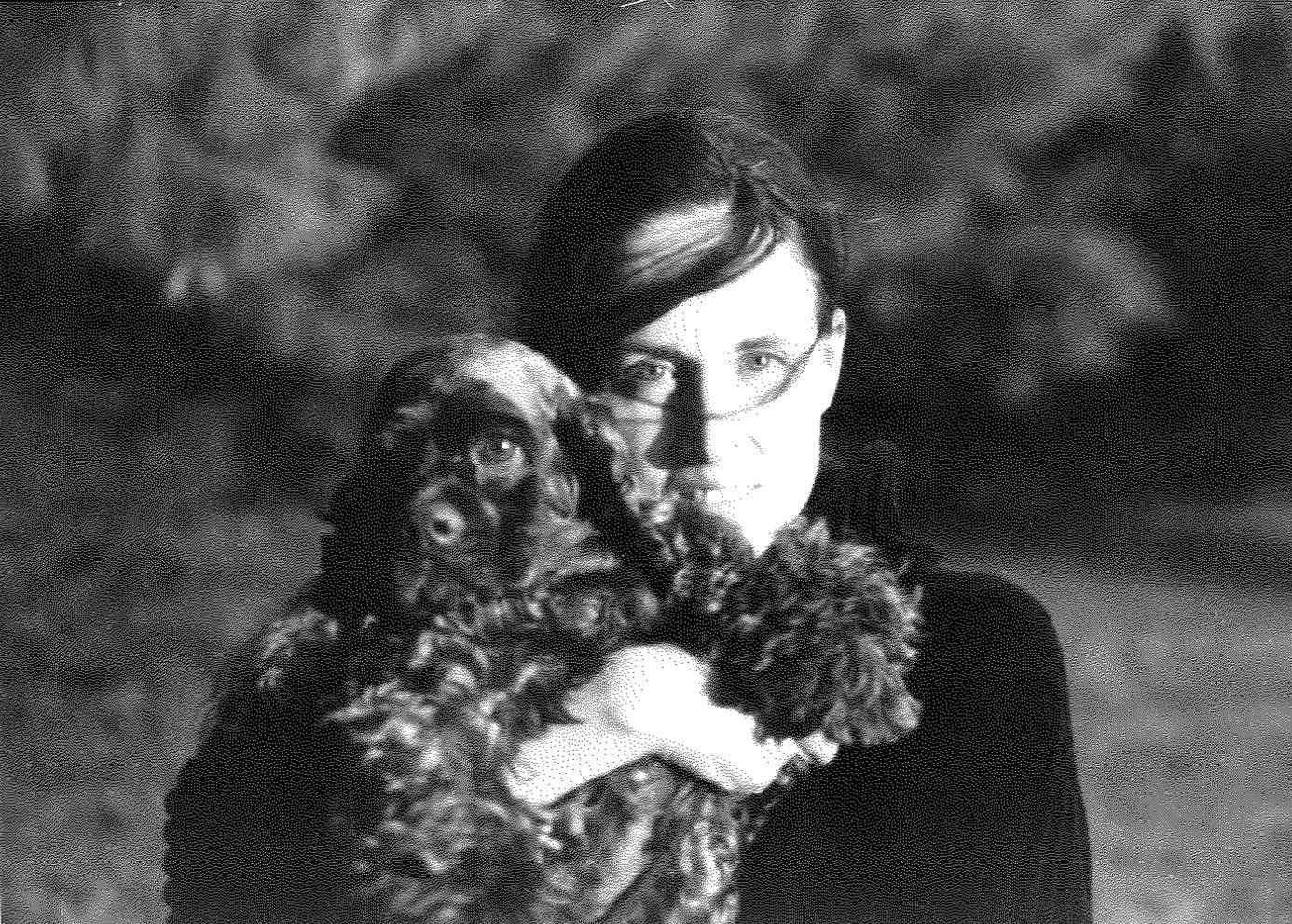
In her last year Daisy looked the same when she slept, but when she awoke it was another matter. She seemed distraught or depressed or discouraged, and I was too. After finding photos that Robert had taken a few years earlier, I was astonished to see how differently she had looked—sturdy, strong, and with a serene expression in alert intelligent eyes—as I held her for the camera. As I saw her go from newborn to aged, it was like watching the abbreviated life span of a person with progeria, the grotesque disease that ages a child prematurely. I had protected my pet from injury throughout the years, but after she fell down the stairs I worried about her safety. As she ate less and her musculature eroded, I walked around with her on my hip, holding her weak hind legs in one hand, while her little head moved from side to side, ears flapping and nose twitching; she was happiest then because she knew without a doubt that she was safe.
My younger brother remarked to me that endless personal sacrifice was possible, but suggested that I consider its effect on others. One weekend when I was nearby, I was unable to visit my mother, who was about to turn 86, because I had to rush back and rescue Daisy from the kennel, where she would not eat. In my exhaustion, I was edgy with Robert who, before we had married five years earlier, had protested against living with an animal. At the time I reminded him that I had known Daisy longer than him and suggested we marry after she died; he relented, and we began to live in his suburban apartment during the week. He learned to like her, but now he was worried about what was happening to me.
My days were now dictated by the diminishing capacities of the dog’s bladder and bowels. She had softly snored at my feet while I wrote two books, but now I was losing writing time, at least 12 hours a week by Robert’s estimate. While I realized that I should not give my dog any more time, I continued to do so. I told myself that it was fine, that it was what I wanted to do. A friend called this masochism, but it didn’t feel like masochism to me. It felt like love, although a difficult form of love.
At night I had bad dreams about losing my dog, and by day I tried to think sensibly about the situation. Someone told me that animals let you know when it’s time, but Daisy gave me no signals. On the one hand, I reasoned, she was not ill, only old, and not in evident pain. On the other I saw that she was getting little pleasure out of life and faced nothing but more deterioration. It helped when Robert pointed out that I was fighting mor- tality, obviously a losing battle. Yet memories of her rebounds let me hope that she would revive again: once after a week of apathy when she began to eat again, she raised her tail and faintly moved it; we pointed to the flutter- ing tail as if it were a miracle, then looked at each other and laughed. Such moments made me vow to keep her going as long as she wagged her tail. Then, suddenly, there was a new low every day. New sores on her back did not heal, to say nothing of the bleeding growth. When she started to spit out the small bits of food I put in her mouth, it seemed that at last she was telling me that it was time. Almost imperceptibly it no longer seemed like I was being loving.
I had been preparing for months, maybe a year, trying to gather the resolve to do what was rational, to put her down or, euphemism aside, to kill my dog. One evening I fell asleep early and awoke around ten, when
Robert told me that he had taken her out for the night. Around one in the morning her pacing woke me, but I was too exhausted to get out of bed. When I went to her at six in the morning, I saw that she had urinated and defecated on the rug, then tracked her excrement onto her bed, where she was lying in it. I remembered a friend’s words about a dog’s dignity, and something in me snapped. I repressed the thought that Robert had not left her out long enough. I realized I had to move rapidly and call the vet before my resolve wore off. I tried to ignore the roaring in my head and the racing of my heart as Robert drove while I held Daisy in my lap, feeling her warmth on my thighs as well as her shocking lightness. I noted that she needed a clip and then remembered that she was too weak to stand up long enough for one. As my hand rested on her back, I felt the sharp edges of her vertebrae and realized that the flesh was already departing her bones, the white bones that had arched so elegantly on the x-ray.
It was Memorial Day, so the waiting room was empty. When the vet on duty asked if I had gone through this before, I nodded no. She explained softly that a strong anesthesia would stop the dog’s lungs and then her heart, and her eyes would stay open. Then she took Daisy from me and went into another room; it seemed like many minutes later when she returned after placing a plastic catheter in her paw. I was certain that Daisy’s clouded eyes looked at me with terror, and that she tried to reach for me; Robert noticed too, and later said that “it was panic not because she knew she was going to die, it was panic because she wanted you.”The vet handed me my dog, and I held her on my lap, stroking the soft fur on her bony back between the open sores and the bloody growth. She knelt down and put a syringe in the catheter. Almost instantly Daisy’s head dropped onto her other paw, while my heart pounded frantically and my head felt as if it would burst with rushing blood.
“Is she gone?” I asked, and the vet nodded yes.
I must have stood up and handed her Daisy’s body because all I remem- ber is leaning over and putting my lips on the little head, on the still warm and silky place that I had probably stroked a thousand times. Robert put his arm around me and we walked away. At home we hurriedly threw away her filthy bed and old woven leash and collar, as if getting rid of them would make her easier to forget. I had wanted stopping her heart to be an act of mercy, not of impatience, and I wondered if I did, indeed, possess a black heart. My weeping in the week after Daisy’s death was also about the real- ity of death. Memories flooded my mind of maimed animals I had seen along the roads, and whenever I saw a dismembered deer, I remembered
Daisy’s last day. I decided on cremation to end the further deterioration of my dog’s body, but I sobbed the afternoon when I was given the grainy gray ashes, when I realized that my beautiful dog was nothing more than a handful of ashes, that my grandmother and my aunts and uncles were nothing but handfuls of ashes, and that all of us are on our way to becoming handfuls of ashes.
A month after Daisy’s death, I was in NewYork City with a teenage niece shopping for ballet slippers for her. As we got off a bus, I suddenly stopped. Approaching us was a tall man with a little brown cocker spaniel puppy on a leash. I let out an exclamation, knelt down on the sidewalk, and the puppy leapt into my lap, furiously wagging its tiny tail and licking my fingers.
“It’s a miniature Daisy!” exclaimed my niece.
As I petted the puppy, I tried to say something to the bemused man, but he looked a little impatient, so I stood up, and he led the puppy away. As my niece and I continued on our way, I realized that the puppy’s greeting was identical to the one that Daisy had always given to me or to any stranger, the one she would have given to the tall man himself.
Although I tried to push the thought aside, I understood at that moment the imprinted nature of a dog’s devotion. Like any pet owner, I had assumed that my pet loved only me; my heart had been enraptured by an eager, easy love, but until then I had no idea how easy it really was. I don’t know why I never noticed before. My animal’s simple-heartedness had made me doubt my own heart for a while, but now it did not. I also understood how effortless it would be to replace her, but I didn’t want to, at least not for a while. Before her death, I had remarked to friends that I would mourn her, and then I would enjoy my freedom. As the days went by, I noticed that they did seem to have more minutes than before. I also remembered what life was like without a pet, and why I had hesitated to have a child. “I’ve done that,” I told myself, reasoning that 16 years was enough, and realizing that my sister was ready to send off her teenage son, the baby who was born a month before my dog. Eventually the other words from Ecclesiastes came to mind, about there being “a time to kill, and a time to heal.”
Around then I remembered the fifteenth-century Giovanni Bellini paint- ing at the Frick Museum, of Saint Francis standing outside his cave in radi- ant light with his arms outstretched to the birds and beasts. All the living creatures around me, I noticed, now had a familiar heartrending aura. Not just the dogs and cats but also the squirrels, chipmunks, rabbits, horses, deer, cows, and even the birds had it. This quality was the innocent and long-suffering one of a mentality that dwells only in a vulnerable present. Now I knew that living with an animal had exercised my heart muscle and habit- uated me to love. My heart had become a locus with my brain and womb as well as the link in between.
This extraordinary, sensitive description of losing a beloved pet is helping me grieve for my geat Siberian cat, Sophie, who was both familiar and my muse. I appreciated Laurie Lisle's link to the loss of other family members and her thoughts about how we are tied together, through the generations, by our love of animals---and how the death of a dog or cat is a way of remembering that we are temporary beings on this earth. We so forunate to meet the people and creatures who sustain us, and offer us such boundless love.


This extraordinary, sensitive description of losing a beloved pet is helping me grieve for my geat Siberian cat, Sophie, who was both familiar and my muse. I appreciated Laurie Lisle's link to the loss of other family members and her thoughts about how we are tied together, through the generations, by our love of animals---and how the death of a dog or cat is a way of remembering that we are temporary beings on this earth. We so forunate to meet the people and creatures who sustain us, and offer us such boundless love.